Left–Right Body Non-Recognition Issue in Generative AI
 sankomenen
Contents
- 1 Abstract
- 2 1. Introduction
- 3 2. Three-Dimensional Space and the Commutativity of Axes
- 4 3. The Non-Commutative Structure of the Human Body
- 5 4. Hypothesis: The Misconception That Only Left–Right Is Interchangeable
- 6 5. The Left–Right Body Non-Recognition Problem as a Design-Level Assumption
- 7 6. Conclusion
On the Non-Interchangeability of the Human Body and Underlying Design Assumptions
Abstract
Left–right body non-recognition is repeatedly observed in current generative AI systems, including image and video generation models. This phenomenon has often been explained as a limitation of AI performance or learning capability. This paper argues that such explanations misidentify the source of the problem.
Treating left–right body representation as interchangeable introduces a systematic inconsistency in generative AI, which directly leads to the observed left–right body non-recognition. The problem does not arise from limitations in AI capability.
It arises from an unexamined assumption embedded during system design: that left–right body representation can be treated as interchangeable, despite the human body being structurally non-interchangeable in all spatial axes.
This paper identifies the left–right body non-recognition problem as the result of a misinterpretation in how the human body was abstracted during system design, rather than as a failure of AI itself.
1. Introduction
In generative AI systems that represent human figures, it has been frequently reported that actions are performed with the opposite hand from the one specified, or that left and right are swapped during interactions between individuals.
These issues are not defects specific to particular companies, models, or products. They have been consistently observed since the era of static image generation.
Conventionally, such phenomena have often been explained by claims such as “AI does not properly understand the human body” or “AI is poor at distinguishing left from right.”
However, such explanations misidentify the locus of the problem by attributing it to the AI itself. This paper argues that this perspective deviates significantly from the underlying issue and obscures its true cause.
2. Three-Dimensional Space and the Commutativity of Axes
Three-dimensional Euclidean space is described using the X, Y, and Z axes.
These three axes are mathematically and physically equivalent, and none of them possesses any inherent or privileged distinction.
Because rotations and reflections do not alter the fundamental properties of space itself, the structure of three-dimensional space can be regarded as commutative.
3. The Non-Commutative Structure of the Human Body
By contrast, the human body is not merely an object situated within three-dimensional space. The human body is a structurally oriented entity, and it is non-commutative with respect to all three spatial axes—X, Y, and Z. With regard to the vertical direction (the Y-axis), it is self-evident that the head and the feet cannot be exchanged.
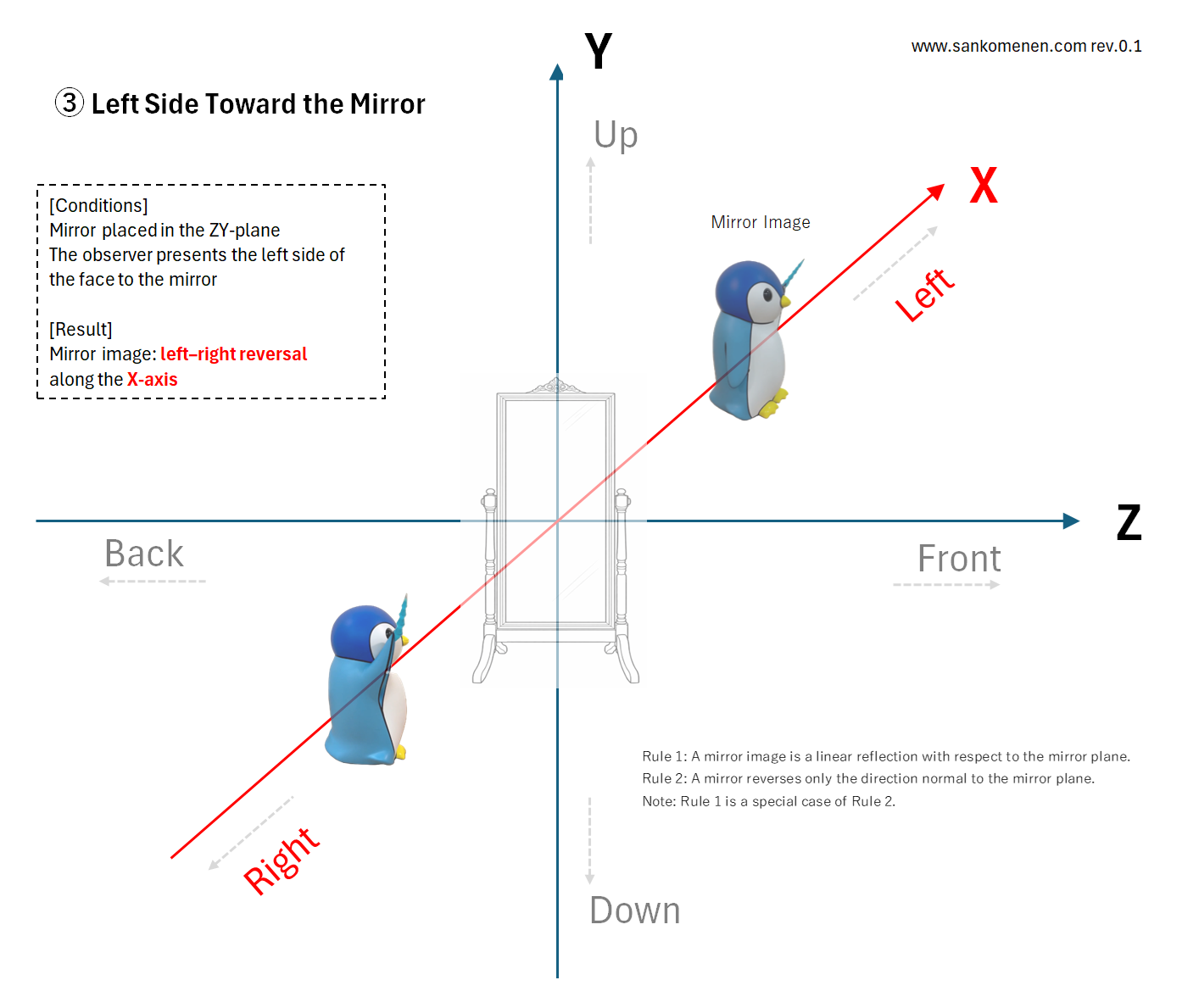
Similarly, along the front–back direction (the Z-axis), the face and the back of the head are functionally and semantically distinct. Reversing front and back therefore destroys the identity of the human body. The same non-commutative property applies, in principle, to the left–right direction (the X-axis) as well.
However, at the level of visual appearance, the left and right halves of the human body may seem symmetric. In static images in particular, it often appears that one side can be easily substituted by a mirror image of the other.
This apparent visual symmetry has led to an intuitively simplified assumption that the left and right sides of the human body are interchangeable.
4. Hypothesis: The Misconception That Only Left–Right Is Interchangeable
This paper advances the hypothesis that, while non-interchangeability along the vertical (up–down) and front–back axes has been explicitly recognized, the left–right direction has been implicitly treated as an exception—assumed to be interchangeable.
Although the left and right hands are similar in appearance, they are not interchangeable in terms of role, function, control, or structural organization.
Nevertheless, it is plausible that, based on apparent visual symmetry, left–right body representation has been approximated as interchangeable at the design level through an intuitively simplified judgment.
5. The Left–Right Body Non-Recognition Problem as a Design-Level Assumption
Based on the preceding analysis, the left–right body non-recognition problem observed in generative AI does not arise from misunderstanding on the part of the AI, nor from insufficient learning on the part of the AI.
Rather, it originates from a design-level premise grounded in an intuitively simplified assumption: that treating the left and right sides of the human body as interchangeable would not pose a problem.
AI systems merely operate in accordance with the representational formats, objective functions, and constraints provided to them.
In the absence of an explicit structural constraint encoding the non-interchangeability of left and right, convergence toward a statistically stable solution constitutes a rational and expected behavior.
6. Conclusion
The left–right body non-recognition problem observed in generative AI does not indicate a fundamental limitation of AI itself.
Rather, it reflects a human assumption formed during the abstraction of the human body—specifically, the tendency to treat the left–right axis as exceptionally interchangeable, despite the body being structurally non-interchangeable in all spatial directions.
This paper has argued that the issue should be reconsidered not as a question of AI capability, but as a matter of clarifying and revisiting the design premises underlying human body representation.